Sunday, October 14, 2018

KHATI THE BEAUTIFUL PAINTED VILLAGE


19th Oct 2018, the day one of my trek to Pindari, I woke up at the KMVN guesthouse Bageshwar to a bright morning and clear skies. The previous evening, Dharam Singh my guide had said that we would leave by 7 am by shared transport to a place called Kharknya from where the walk to the village of Khati was about 6 kms which would be our resting place for the day. Dharam Singh had promised that he would bring the vehicle to the doors of the guesthouse instead of us walking in the market place trying to find one. I guess he was probably trying to make my life easy. But it was 8 am by the time a vehicle arrived. Dharam Singh explained that he contacted another vehicle but it didn’t turn up, so it took him a while to locate another. I could see that neither Kharknya nor Khati is a frequently travelled to destination. The road passes through several small towns like Bharadi, Kapkot, etc., and there were more passengers for these destinations. We two and a vet doctor were the final ones alighting at Kharknya.

At Kapkot we requested the driver to stop at the Forest Department office so that we could register that we were on our way to Pindari. The recent decision of the Uttarakhand High Court banning all treks in the Himalayas wherein people pitch tents in the mountains has led to a lot of confusion. The Forest Department wasn’t permitting anyone to carry tents up the mountains, and one had to stay in some hotel or guesthouse. I paid a fee of Rs. 100 for registering myself and took a receipt.  

The vet doctor Himanshu Pathak shared some very interesting bits of information. He was going to Khati to check out a poultry farm which was funded by state government grants. The state government was trying to encourage more streams of livelihood for the population living in the mountains. He explained that wild animal attacks were a cause of concern lately. There was a leopard which was stealing goats and killing children. A villager near Bageshwar was the hunt of one such animal wherein local villagers had set a trap for it, however the animal wasn’t ready to be fooled and it went around the trap knowing that there was a goat inside but wouldn’t enter. The villagers had phone him and told him to bring along his tranquilizer gun but since he had already started his journey to Khati, he passed on the responsibility to his colleague at Bageshwar.  

For going to Khati there were two routes. One road went to Loharkhet and from there one had to trek up the mountain to Dhakuri which is at 2700 meters before descending to Khati, about 16 kms. Another road which is still under construction at several places goes till Kharknya and one has to walk through the forest. The road from Bageshwar to a spot called Mujwa Binayak, which boasts of a scenic spot overlooking a valley, a Ganesh temple and a fairly decent hotel, is pretty tolerable though there were disturbances. From there to Kharknya the road isn’t asphalted and is severely affected by erosion and landslides; it has been constantly under maintenance making it dangerous.

From Kharknya the actual walking to Pindari really starts. The road to Khati runs through a dense forest, with beautiful small waterfalls. It is more or less even, broad and doesn’t pose much of a challenge. Khati at a height of about 2200 meters above the sea level is a picturesque hamlet surrounded by tall mountains and dense forests on all sides with the looming ice-clad Himalayas to its north. It’s a very small valley of sorts and is just above the junction where the Pindar River and the Sunderdung River streams flowing from their respective glaciers merge together. Khati is on the left bank of the river, the land sloping towards the south in the direction of the river. The gently sloping land which is about 562 hectares has been claimed by population of 314 villagers for their 66 houses and agricultural fields (all figures as per the 2011 Census). Khati village is about 60 kilometers towards the north of Bageshwar the district headquarters, and is the first stop on route to Pindari glacier. 


As one turns the final bend on the path towards Khati, one is struck by the cluster of colourful houses at a distance. They are all clustered close to each other as if tucked away together in the midst of green trees. As one enters the village, there are a couple of boarding and eating facilities on its outskirts. KMVN also has a tourist rest house at Khati which is at the other end of the village towards Dwali. Apart from these, there is also a PWD guesthouse.  Tourists can easily find accommodation and food without any prior booking, or else they can pitch their own tents. However the phone connectivity is extremely poor, inspite of there being a Post and Telegram Office in the middle of the village. 


When in the village, one is awestruck by the multicolour painted houses. With a base of a bright colour, each house has a different theme painted on it, depicting persons of repute belonging to the owner family, local village scenes, and various kinds of patterns and designs. The walls and doors are painted with different colours. Most of these houses have two floors and a few of them are three storied. A few new one are made of clay bricks with cement concrete while most are made of wood and stone. Most of the houses are fitted with solar lighting since there is no electricity at Khati. Most of them have piped water and also in-house toilet blocks. For a small village, having these modern facilities came as a surprise, but this is all because of Hans Foundation whose members and volunteers,  a couple of years ago had set up camp at Khati for a couple of months and transformed the village. There are a couple of schools in the village primary and secondary and kids from all nearby places study there. Khati had a primary health center in the past and the village boasts of a small hospital building. But this is no more in use.

Khati used to have snowfall in the past and was inaccessible during the winter months. Of late however there has not been any snowfall for the past few years. Trekkers and mountaineers have always been using Khati as a pit-stop on their way to the Himalayas. The main occupation of the villagers is agriculture and they grow various crops along the mountain slopes. Several of them also cater to the tourists.


Another striking thing that one notices at Khati is the rampant cultivation of Charas. Charas or Ganja is the name given to a hashish form of cannabis which is handmade. It is made from the resin of the cannabis plant. After the main cropping season, before the onset of winter, the farmers allow cannabis to grow wildly on their lands. They then crush and roll the leaves of the plant with their bare hands into a thick pulp form and sell it to the brokers. Charas is a cash crop which fetches the farmer around Rs. 30,000 a kilo and all family members are involved in this trade. Over the centuries Charas has been consumed by the Sadhus as a ritual and therefore also has a cultural connotation. Even though declared illegal by the government the Charas cultivation continues openly. 

One also finds the younger generation of schooled boys and girls changing their occupation. Previously agriculture, goat and sheep rearing, joining the army and tourist guides to the Himalayas were the only source of income. Nowadays a lot of youngsters are moving down from the mountains to the plains to pursue higher education or jobs in the cities and towns. Life in the mountains is physically tough and devoid of all modern growth and also entertainment facilities which are provided by the internet.    

Khati gave me the impression of an idyllic very well knit village. The village plays host to foreigners trekking to the Himalayas and therefore is exposed to modern thoughts. And yet, since it wasn’t reachable by motor vehicle directly, it manages to remain on the fringe of modernity, in a buffer zone, which also isn’t an uninhabitable place. It has an exotic aura to it, being just within striking distance of the snow clad mountains, and yet just out of reach of crowded habitats. Its weather threatens to be severe in the winters and yet people survive to make a reasonable living all through the year. To normal imagination it is a raw place to live, and yet, to those who are easily satisfied it offers a sublime lifestyle.  It is my sort of dream place to retire to.    


Sunday, September 30, 2018

DARING ESCAPE FROM DWALI (PINDARI) SEPTEMBER 2018


Date: 22nd September 2018. It rained strongly all through the previous night and the sound of rain drops striking the tin roof of the KMVN tourist rest house at Dwali would not allow me to sleep soundly. It woke me up several times during the night whenever the crescendo rose beyond the sleep permitting decibels. I could sense a worry in my heart, and the question arose whether I would be able to walk down to Khati in the morning.  Rain is the most ominous event in the Himalayas for trekkers because all movement along the path comes to a halt due to dangers associated with mud, rock and land slides. Heavy rains are a dread. When I got up in the morning, the first thought was to look up in the sky and assess the threat potential of the clouds. Well, it was a sinking feeling in my heart at first glance. Possibilities for walking were slim and depended entirely on the sky clearing during the early part of the day.  


Date: 21st September 2018. The previous morning the 21st Sept, was normal, me accompanied by Dharam Singh (my guide) had ventured out very early at the strike of dawn at 5.30 am from Dwali to reach Pindari Glacier which is at 3600 meters and the plan was to get back in the evening. It was a 24 kms stretch to and fro and promised to be tiring. From a Pune group which returned the previous evening from Pindari, I learnt that it had rained at Phurkia the day before, but I took it lightly because there was no trace of rains at Dwali. Fortunately at about 12 noon, after reaching I could get a clear view of the snow clad peaks of Baljodi, Panwali Dwar, Nanda Kot and Shanku in very bright sunlight and spent some wonderful peaceful time near the Pindari glacier mouth. The path was extremely treacherous and to top the danger levels the rains started when we reached Phurkia on our way back. We walked back in the rains till Dwali. The exuberance and sense of achievement that I felt after completing 24 kms in 12 hours and having pocketed some beautiful sceneries made me feel invincible though extremely tired, thus my mind refused to recognise the serious threat that the rain posed. At Phurkia over lunch we met Debda (Deb Mukhopadhya) and Basuda (Basudeb Majumdar) both trekkers from Kolkata along with their guides Anand Prasad and Bhupendra Prasad, brothers from Khati. We were together again at Dwali in the evening. Having made our independent plans for the next day, we retired to bed after dinner. The rains had stopped in the evening only to start again in the night.      

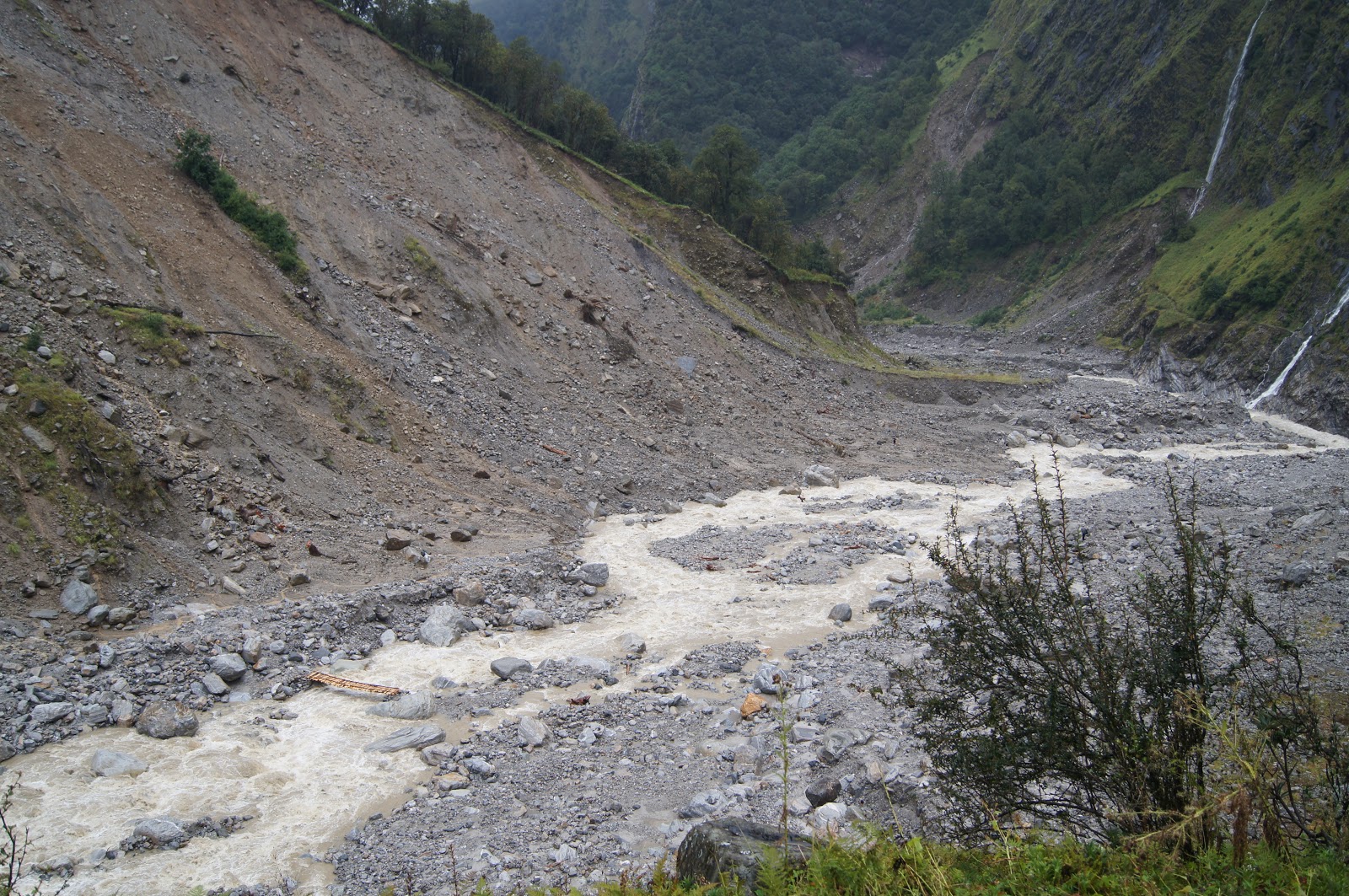
Date: Back to 22nd September 2018. Dwali at 2600 meters is a mere rest stop with a KMVN tourist rest house and a PWD rest house, both perched on a hill and overlooks the confluence of two rivers flowing down from the Kafni and Pindari glaciers which then flows as the single Pindari River. There are no other inhabitants. The immediate nearby village is Khati below at 2200 meters with about population of around 1000 persons. The path to Khati is on the right side of the river and to reach there one has to cross two temporary wooden bridges, first over the Kafni river and the second over the Pindari river. The overnight rains in the mountains above had bloated the rivers and I could clearly see in the morning that it had become atleast five times its size as well as intensity from the day before. My earlier plan to start out at 6 am in the morning and that of Debda and Basuda to start out after breakfast around 9 am were immediately shelved. The guides trio heralded a gloomy prediction that the bridge over the rivers probably got blown away in the overnight heavy showers. Moving to the edge of the plot we could see the bridge over the Kafni existed but the next bridge isn’t visible unless one walks half a kilometer ahead and turns a curve on the path. We were however discouraged from exploring for 3 major reasons. One was since the Kafni river was flowing beyond the edge of the bridge by 5 feet on both sides. The second was immediately after the Kafni bridge the stretch of 200 meters was prone to rock and mud slides and we could see huge rocks constantly coming down every few minutes along with mud up to the edge of the river since the morning. The third was that it was raining non-stop.


That day there were around two dozen more men at Dwali, of which 12 were ‘Anwals’, goat and sheep owners taking their livestock down to the plains, and around 6 were mule owners who were also going home after delivering their load. After discussion we six thought it best to allow them to make the first move in the given situation since they belonged to the place and had more experience with the elements. At about 9 am we observed a few Anwals going to the Kafni bridge with their umbrellas to assess whether their livestock would be able to cross it. They tried to move a few rocks but very soon gave up. Meanwhile we had our breakfast. The guides said that immediately after the Kafni bridge there was previous path on the left bank of the Pindari river as well, but now destroyed after the 2013 deluge and not in use. Afterwards the path on the right bank was newly constructed. The left bank path was now overrun by the forest. We decided that if it stopped raining we would think of making a move. However we still wanted the animal owners to move first.

At about 10 am, we observed two persons moving, one Anwal had crossed the Kafni bridge and was running down towards the Pindari bridge to save himself from the rock slides and the other man was coming from below and also trying to reach the Pindari bridge. We waited with baited breath, expecting good news about the bridge. After a while the Anwal returned alone running, and soon we learnt that the Pindari bridge didn’t exist anymore. The other man coming from Khati had turned back. We were now resigned to our fate. What could we do if the rained wouldn’t stop? We just had to wait it out. The rest house caretaker asked whether he could prepare lunch for everyone. We all affirmed since there was no other plan in our thoughts. We ate our lunch quietly with worry in our minds as to how long would be last in this place. The food available at Dwali would soon be over and with the Pindari bridge destroyed, there would be no supplies coming up. The reconstruction of the bridge itself would consume 2 to 3 weeks since it is a PWD task and would be done through the tendering process. But that would begin only after the rains stopped which is an unpredictable unknown factor.

And then the madness took over. The insane rush of blood!


Soon after 12 noon, Anand Prasad the elder brother, God bless him, advocated that if the rains continued unabated, very soon the Kafni bridge too would be washed away. After that even the left bank path would not be reachable. He wanted all 6 of us to decide immediately and make a move. It was about 12 kms to Khati and walking on the left bank of the river we would be able to make it before nightfall, even with the rains. If we didn’t reach before it got dark, then there were torchlights and mobile phone lights to guide us. Debda and Basuda concurred with him immediately but I wasn’t sure. I wanted Dharam Singh’s opinion but he wasn’t anywhere around. I couldn’t imagine all the dangers of this destroyed path and thought Dharam Singh might know. Bhupendra Prasad summoned him and Dharam Singh surprisingly agreed to the proposal. Now we all were committed to the task, come what may! The rains wouldn’t stop and neither would we. We hurriedly settled the rest house bill and got ready. We left Dwali just before 1 pm with all our bags.

Anand Prasad was always at the lead and Bhupendra Prasad covered the rear. Our first challenge was the Kafni bridge. We weren’t certain about its durability now. We walked through the extended river and slowly crossed the bridge one by one. That over, immediately Anand told us to run so that we could move beyond the rock fall region. We all did as told. Without taking our eyes off the ground below we scampered and crossed the 200 meters stretch without an accident. This was our first victory over the challenges on the path. Naively assuming the worst to be behind us, we posed and clicked a few photos with our mobile phones in celebration.  


 The difficulties on the uncharted track unfolded themselves one by one. Each one, far more severe in degree of difficulty, to the one before! I call it uncharted on afterthought because we walked besides the swollen river most of the way while the actual erstwhile path must have been several meters above the river bed. The inflated Pindari river was on our right side making a deafening noise as it fell over the huge rocks, and the added rain water pushed up the decibels several notches and also made its current stronger. The 12 kms stretch contained more than a dozen streams dropping from the mountain slope on our left. Some of these streams were wide while some were very steep and had tremendous force. At several places the slope on our left side was a rock and mud slide area and everytime we came across one, Anand shouted at us to run. At one such place, Debda was just a few steps behind and had slowed to take a little breath.  Anand saw that his life was in danger as a lot of mud and stone was rolling down from a few meters above. He ran behind to pull Debda out of its path and they missed getting caught in the middle of the mud slide by a few seconds. At another place the stream was flowing down strongly with mud and stones. At a few spots it was stagnant but that could be a deep sinkhole of wet mud. Anand was at his wits end, unable to decide from where to tackle it. He was jumping from rock to rock trying to fathom which one was a rock and which one was merely wet mud. Meanwhile Bhupendra ventured to its base near the river where it was at its widest. Anand lost his cool. He was shouting at his brother at the top of his voice to return back and it seems that some terrible accident was about to happen. But fortunately Bhupendra managed to climb back again to be with us. Anand then found out a least dangerous passage which obviously had wet mud and I fell into it and sank up to my thighs. Pulling my legs out of the mud was an effort. Some of these slopes where we had to run across trying to save ourselves from falling rocks and mud, were at steep angle of around 60 degrees and without any foothold or marked path. We simply had to run when we were told to run. At a few places the river bank had no space to walk because the flowing water was touching the steep slope. At each of those spots we had to climb up the slope, into the forest, with nothing to hold at except lose soil and wet shrubs. The vegetation was thick, some bushes were thorny, and some were downright harmful causing rashes when they touched our skin, while a few like the bamboo were helpful. Touching the vegetation also made our hands and legs vulnerable to attacks by Leaches where they simply stick on to the exposed skin. I caught a couple of them on my legs. Negotiating these steep slopes going up and coming down is unimaginably tough and we three outsiders slipped and had to be saved innumerable number of times. On a couple of occasions we had to walk through the forest. Anand and Bhupendra were making a lot of loud noises during those stretches, both going “U-lu-u-lu-u-lu-u-lu” and “Harrrrrrrrrrrh”. When I asked them what they were doing, Anand replied that he was trying to turn the wild Bears and Leopards away from us, avoiding an encounter. I was too shocked to be taken aback but all hair on my body stood on its ends. At another place which was a fast flowing stream, Anand told us not to lift our feet while walking across the water, but just to slide push it across, because the flow was extremely strong. We three outsiders had a terrible time that evening, we fell several times negotiating the rocks on the river banks, we had to be saved several from, being directly pulled by Anand and Bhupendra with their bare hands from the jaws of certain death.


During our talks on the way, soon our target became the metal suspension bridge on the Pindari river about 2 kms from Khati. We wanted to reach the bridge before darkness took over the valley. Several times we asked the Prasad brothers, how far was to bridge, and each time they replied “15 minutes away”. We had been walking without much rest, running as well on several occasions. We were extremely tired. The three guides were carrying our backpacks, but we three were exhausted beyond our belief. At about 5.30 pm we got our first glance of the metal bridge at about a kilometer away. Anand said that there was one last stretch which has to be run across and we better hurry because the light wasn’t too good. Before that we had to climb up once more into the forest above and then come down, but this time we ran through the forest once again making a lot of noise. The last rock slide stretch came up, which we ran across in extremely poor visibility. After that we once again had to climb into the forest above, but this time we had reached the final path, the rock paved road just 2 kms before Khati, our destination. The time was 6 pm. We had covered 10 kms in 5 hours. We were extremely happy, relieved and grateful that we managed to survive the nightmare. We walked up the final 2 kms to Khati slowly, to safety of the Krishna Hotel, to welcome food and rest, and away from the unknown perils of Dwali. We thanked the Prasad brothers and Anand specifically for singlehandedly saving our lives on several occasions. His leadership capabilities and courage of the spirit was powerfully evident during those hours. He knew the track, had judged the risks, had assessed our capabilities and finally stitched in our commitment to the task before embarking. Hats off to him.

Date: 30th September 2018. We had experienced a miracle that evening, infact we were the miraculous survivors. To this day I am unable to comprehend how we managed this, how we covered those 12 kms in 7hours, without any accident, walking and running through rock and mud slides, in the rain, through wild forests and so much danger. A hundred different kinds of mishaps could have happened to any of us and yet we got through with a few cuts and bruises. Surely, it wasn’t merely of our doing. The supreme powers walked besides us that evening.     

Later I learnt from Dharam Singh that the Kafni bridge too had washed away the same evening after we left and all the men and animals had to wait for a few weeks to get out from Dwali.

From the news channels I came to know that it had rained heavily across several parts of the country and more severely in Himachal, Haryana and Punjab during those 3 days from 21st to 23rd September 2018 causing extensive damage.

I express my gratitude to everyone who shared this experience with me and because of whom I am still alive;   
Mr. Deb Mukhopadhya, Baidayabati, Hoogly, West Bengal.
Mr. Basudeb Majumdar, Shyamnagar, North 24 Paraganas, West Bengal.
Mr. Anand Prasad (Guide) Khati, Uttarakhand, 9410312519 (Post him a message if the number is not reachable, he will call you back).
Mr. Bhupendra Prasad, Almora, Uttarakhand, 9410107816.
Mr. Dharam Singh (Guide), Supi, Uttarakhand, 9536009972.


Sunday, September 16, 2018

DESPAIR AND PAIN


One early morning, a young man, an complete stranger, stopped his two wheeler near me, during my walk, and with pleading eyes overwhelmed with vulnerability, without a word of introduction, blurted out his first question, “zindagi kya hai?” followed by his next question “zindagi kaisi jeeni chahiye”. I was taken aback. My first reaction to him was “what happened?” We got talking and then he explained that he has been feeling very low and upset over the past two months after his eldest didi died. He claims that she was killed by her in-laws and they picturized it as a suicide. She was married for four years and had a baby girl of two and half years. He had spoken to her on the day she died and she had not said anything untoward. His contention is that she wasn’t the kind who would kill herself but there is absolutely no evidence against her in-laws that they ill-treated her in any manner. Her in-laws are rich and can afford to pack the police. Their neighbors too aren’t willing to say anything against them. He had tried to find some proof but after the police had closed the case there was no recourse whatsoever. The despair in his eyes, the pain and the helplessness, made me cringe inside.

It reminded me of my similar state of mind a few decades ago. A mother had died, in front of her husband and children, unloved and uncherished. They pass away unable to bear the torture, but their close ones who remain behind suffer untold trauma. To come to terms with the reality of the loss takes its toll in terms of number of years down the drain, and one has to live with an unshakable shadow of guilt and a psychological vacuum as well. Questions crop up which will always remain unanswered. The pain inside becomes numb but never goes away. It remains alive and you can feel its contours everytime you sit alone quietly by yourself.

The subject matter of this piece isn’t someone’s death. Rather it is about the feeling of desperation, the accompanying pain and the crying search for a helping hand to get out from the sinking quicksand. All living creatures go through pain; some lose out while some survive. Even the basic process of survival when seen from the angle of feeding is accompanied with pain. For instance, the food chain defines the victors and the vanquished. Gautama Buddha stated that pain and sufferings are inevitable. While he went on to elucidate a way out of the worldly pain, presently let us throw some revealing light on how to deal with pain.

Ask for help. It is absolutely fine to ask for help. Like this young man above who simply poured out to a stranger. It is not expected that others would be able to resolve your matters, and maybe not everyone can be expected to be able to deal effectively with a person in pain. However the act of expressing ones inner pain itself acts as a soothing balm. The unburdening of the heaviness of the mind in front of someone, who is just simply willing to listen, is more than enough. An outlet is required for the rancid thoughts inside, and the mind becomes capable of healing itself.    

Remain calm and equanimous. A balanced approach to the matter is essential. The wise ones say that one shouldn’t go into extreme displays of emotions both during joy and sorrow because these are merely temporary. They pass and life goes on with its new set of ups and downs. Overreacting only serves to accentuate the pain, both in times of joy and sorrow. Dramatizing your personal pain could lead to other complications like souring of relationships with others.

Acknowledge. Accept the existence of the pain and deal with it. See it, feel it and it will slowly lose its intensity. Do not ignore it. The emotion of pain inside is seeking an expression, it wants to be addressed, it is searching for a relief, a cure. Disregarding or snubbing the pain would only make it fester and turn malignant. Turning a controllable grievance into an uncontrollable demon will cause more harm in the long run.  

Change the perspective. The perception which we hold in our minds, our belief systems, our faith parameters, related to our life priorities, our concepts of living, the way in which we approach life, carries a significant lot of importance. They can block or unblock our life. They can make us adamant or obstinate on certain matters and relaxed and fluid on other matters. Pain and despair are signs of mental or psychological blockages. The level of acceptance is low because we cannot agree with the present reality of our life as it has turned out.  A slight change in perspective goes a long way to settle down the rising waves of despair.

Be positive.  Nature is transient. It is changing constantly. It is wise not to take life too seriously. Customs, beliefs, practices, knowledge keeps changing. What was considered sacrosanct a few decades ago becomes a joke later, for instance once upon a time the Earth was considered flat by the westerners. Pain is a hurting feel of loss. It arises when there is a sudden change and it could arise due to several factors. But when change itself is inescapable, it is rather negative to hold on to it. Accepting the change and moving on is positive. A positive mindset heals the pain quicker.  

Pleasantness of mind. A pleasant disposition helps to overcome and face the suddenness of changes that take place around us. A calm temperament, an easily laughing character, a constantly smiling face, a personality that sees the bright side of every issue, can get over obstacles much faster than others.  Survivors are always those who adjust with the reality. Meditation helps in achieving this.  


Seek expert advice. Not everybody is equipped to deal effectively with pain. Some internal constitutions are weak and those persons do get overwhelmed by the situation of pain. In such circumstances it is better to seek the help and advice of experts.

Sunday, September 9, 2018

THE QUEERNESS OF AGEING


This piece isn’t about the making of wine. Howsoever egoistic it may sound I have to confess that it is about me. We use the term ‘ageing’ rather loosely to suggest getting old as in an opposite to coming of age. Now when it is almost 52 years since the day I was born, I wonder whether I should or could place myself into the ageing category. Why should I or why should I not? Either ways, I am not clear about it. Permit me to elaborate on my confusion.

The ageing process intrigues me constantly. The question that often arises in my mind is what exactly is meant by ageing. Do we really age and how do we age? How does it feel on an experiential level to age? Can we be aware of this process, see it happen on a minute by minute chronology. The various aspects of ageing too baffle me. Is ageing a physical, mental or a psychological subject, can we age in relationships or even experience, does ageing mean more knowledge and wisdom, is ageing becoming infirm or getting better, maturing, does ageing mean tiring, does ageing equate to disinterest in the world around and starting out on religious or spiritual journey. Is ageing a journey? Where does it lead to, are we aware of this transition, would there be a destination where we can finally say that we are no more going to age. Is ageing merely a change in properties taking place spontaneously on its own wherein we don’t have any control, whether we like it or not. There are several such questions that crop up in my mind when I ponder over the thought. I am still seeking answers.

Soon after becoming aware and being able to remember events, growing up in the rural outskirts of Margao, the constant memories of my childhood have been open landscape, walking through greenery, trees of cashew and mango, and Hindi songs in the afternoon on radio. These images are stitched together with emotions of blissful calm and peace of childhood, feelings existing prior to the competitive teens, those before fear, hurt and anxiety took over. Today whenever I see visuals of open and green landscape, whenever I am in the midst of huge trees, or whenever I hear a Mohammad Rafi or a Lata Mangeshkar, I find myself transposed into the body of the young boy, seeing things from his small eyes, touching things with his tiny fingers and remain transfixed at the awesomeness of the beauty around. I still explore as I used to, wonder at the stories that the trees are telling me about other wayfarers, imagine how the rock came to its present resting place, wonder whether man appeared before or after the mountains came up, contemplate on why all these exist in the first place. I listen to the tales that my mind conjures up and smile, laugh and get bitter with its twists and turns. When I tread on a forest path or sit under the shade of a tree, I wonder whether any saint has done the same before. I become the same kid, we are one again. Age becomes meaningless and the connect between the two of us is electric, welded together by lightening right at that moment. How do I justify ageing, I don’t know what that word means.

As kids we didn’t have a wristwatch and distance was always measure in time. So to reach the playground or a friend’s house would be measured in terms of time it took the sun to reach from say a 40 degree angle to 30 degree angle of the eye. We either hurried or went leisurely depending on the position of the sun. We were not permitted out to play when the sun was right above our heads. Then returning home would also be measured in the time it would take the dusk to convert into darkness. This self-training of childhood still stands the test of time, is still foolproof and not dependent on the power of the batteries inside our wristwatch. I still abide by this gut feeling and try to guess the time on my wristwatch. There are many such learning from the childhood, for instance how to distinguish the good man from the bad, how to select fresh vegetable and meat, how to predict whether it will or won’t rain immediately, how to tell whether my body is ready for a game, a workout or it needs some rest, how to tell whether I am going to be sick or whether it is a passing feeling and I will be better in a few minutes. These internal decisions were never taught or explained and I have never come across them in any book in all my adult life readings. How do I accept that I’m ageing?     

As a small boy, walking half a kilometer, would take a pretty long time. The same place when I walk today doesn’t take all that much time that it used to. The immediate question in my mind is whether the PWD has cut off some parts of the road that existed long back. I see no other explanation. My feet are the same because I have been seeing them for the past several decades. Then how did the time reduce.  The perplexity is internal, in the mind. The question is raised by the kid and answer too is sought from the kid. The present 51 year old man isn’t credited with a better understanding than that of the 5 year old kid and this is factually true. Wonder what the fuss about ageing is.

Physical changes in my appearance have always been there and as long as I can remember. Over the years I have seen my weight and dimensions change back and forth. Hair has disappeared and appeared at different parts of the body. Physical internal pain has been a constant companion of this body and it has only altered its place of residence time to time. A cut or bruise always drew blood and swelling whenever and wherever they arose. Several habits of the body like sleep, food intake and excrement of waste remained more or less the same. With the passing of the years, things have remained the same even when they have changed a lot. The body has this innate ability to recreate simultaneously as it extinguished. The mechanisms inside the body create new cells as soon as it loses existing cells. At some stage or point in time, due to both physical and psychological reasons the body mechanics and functionalities starts to slow down and eventually stop. This stoppage is death and can happen at any age. This death can happen suddenly as well and also be brought about by external factors. We should always strive to lead a healthy live and ensure protection and care for the body at all times but whenever death comes there isn’t much that we can do. Death therefore cannot be linked to ageing. What then is ageing, the question persists.


The concept of ageing is not without its benefits though. Some people bracket those whom they consider aged as respectable. They are accorded extra sympathy and more often than not treated with kindness. The expectations from the elders are considerably scaled down and life becomes stress free. These low hanging fruits are very attractive and tempting and most of us give in, earlier than required. My predicament is that sometimes I find myself still continuing to reside in my childhood. People have entered and left my life, I have seen and experienced many events and they have left varied impressions of joy and sadness inside, but the desire to grow up and become responsible hasn’t sunk in or taken over completely. At times I can’t understand why certain things are happening in my life. Good or bad, I haven’t grasped ageing as yet. It’s rather queer.